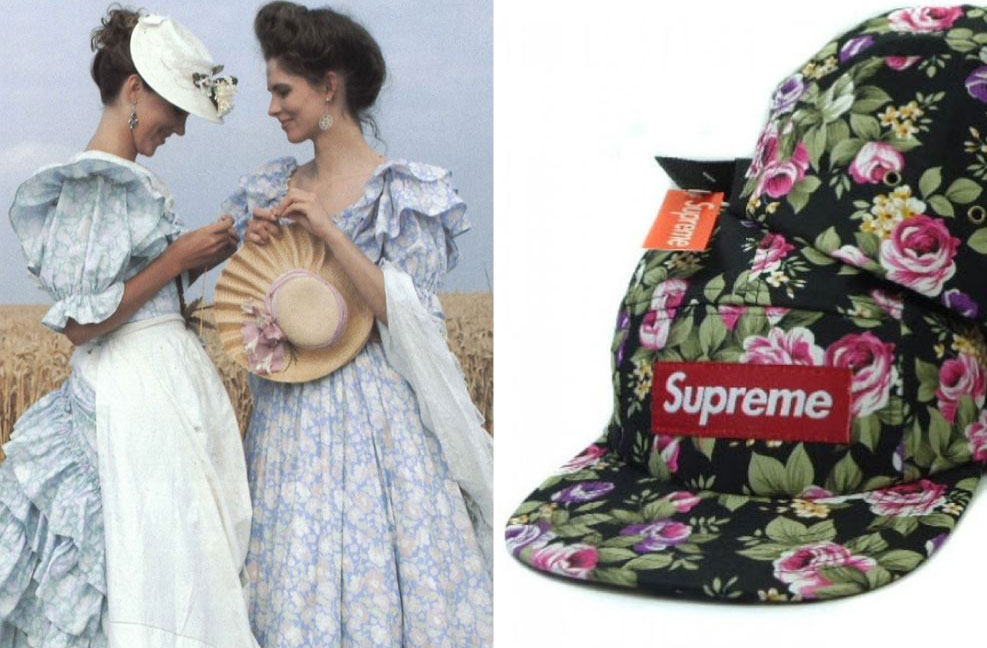
How did streetwear brand Supreme sell Laura Ashley’s aesthetic when Laura Ashley couldn’t?
Heritage brand transformations often fail because executive leadership focuses on sales and relevance.
Consider this contrast:
Laura Ashley and Supreme.
Once the icon of English fashion, the former was known for its dense floral patterns. After the death of its founder in 1985, however, the brand lost relevance. By the end of the nineties, eight chief executives had come and gone.
“Each new high-flying executive has taken the firm further from its historic roots and strengths,” the BBC observed at the time.
Ashley’s husband continued to chair the company and, reportedly, “frequently clashed with chosen chief executives as the floral look became more and more outdated.”
Enter Supreme: A couple of decades later, Supreme used old-fashioned, cabbage rose prints for its apparel. With the brand name emblazoned over what looked like Grandma’s old curtains, Supreme made floral cool again.
Later, Supreme even used Laura Ashley prints.
Supreme created what Israeli biologist Amotz Zahavi dubbed a “costly signal” or a “handicap signal.”
A peacock’s large tail feathers make it easier to catch. So peahens know that a peacock with a very large tail must have superior survival skills (which will likely be passed to their offspring).
Among humans, a costly signal might be a classically handsome man getting tattooed or a classically beautiful woman cutting her hair short (rather than wearing it long like her romantic rivals).
In the drama series “Your Honor,” the crime boss Jimmy Baxter tells his son not to wear a tie with his suit, even though all of his staff do. His point? By looking a little less polished than your subordinates, you signal to everyone that you are the one person who doesn’t need to adhere to the rules—because you’re the one in charge, and you’re the one setting the rules.
In human culture, costly signals, such as not wearing a tie or getting a tattoo, aren’t just about standing out. They’re about displaying guts, self-confidence, risk-taking, standing for something, and surprising whoever happens to be looking at us.
Laura Ashley’s chief executives tried to catch up with consumers. They moved away from florals because florals were losing popularity. They tried different things. But, by doing what was rational and justifiable, the executives displayed a lack of guts, a lack of self-confidence, and an unwillingness to take a risk (and, risk-taking declines with old age, of course).
Laura Ashley went off-brand, and it failed. Its executives were trying to resuscitate the brand.
Through costly signaling, Supreme reminded us that they were risk-taking, adventurous, bold, brazen, cool, and youthful enough to pull it off.
But, more than that, Supreme also made us see the world differently (through Supreme’s eyes).
